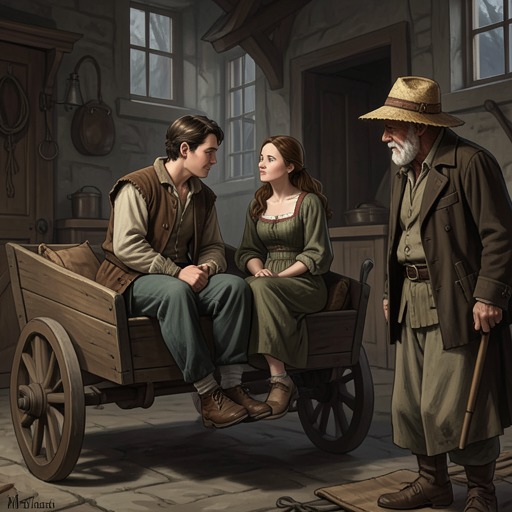
Ulrika and Elin’s Mother-Daughter Relationship
The EmigrantsUlrika and Elin’s relationship is at once a bond of protection and a promise of escape: Ulrika’s hard-won care sustains her daughter through poverty and shame, while her faith recasts their journey from Sweden as a passage to a new life. Aboard the emigrant ship, that devotion becomes both practical and possessive. Ulrika fiercely guards Elin from Robert, yet her daughter’s memories reveal the sacrifices and tenderness beneath her mother’s vigilance.
A bond formed in poverty
Elin knows that she was born outside marriage and that people have made her feel this difference since childhood. Her recollections give the stigma a physical setting: when men visited their home, Ulrika sent her outside and locked the door. In winter, Elin waited in the woodshed wrapped in a warm sheepskin. There was often little food, sometimes none; when a visitor came, Elin understood that food would soon follow. She liked many of the men, though some mistreated her mother. Once, when a man struck Ulrika with an ox-whip, Elin threw a pressing iron at his head and helped her mother push him out.
The child did not initially know why only men came to visit. As she grew older, Ulrika explained their purpose, and Elin did not think her mother had done anything wrong. One night, hearing sounds from a visitor, Elin mistook them for her kitten. She later spoke to Ulrika about what she had heard; Ulrika forgave her and cried, then told her what people had done to her. Elin recalls that as the only time she saw her mother cry. From then on, she never thought ill of her. Her loyalty is not founded on an untouched or idealized childhood: it grows from the knowledge of what Ulrika endured and from the mother’s willingness to explain it.
Elin has no sure knowledge of her father. Ulrika thinks he may have been a cheerful itinerant who once lodged at their cottage and played the violin; she also names the churchwarden, Per Persson of Åkerby, as a possibility. Neither mother nor daughter wants that second possibility to be true: Elin considers him evil because he called Ulrika a whore, although both women believe themselves reborn in Christ and washed clean by his blood. Their shared faith answers, at least within their own understanding, a society that reduces Ulrika to her sexual past and Elin to her birth.
Protection and expectation aboard ship
On the voyage, Ulrika’s protectiveness turns outward as a warning to Robert. She sees him lingering around Elin when her back is turned and rejects him as a poor farmhand with little to offer. Her suspicion is grounded in her own experience of men who take what they want and leave. She is determined that Robert will not get access to her daughter, whom she imagines as a “God’s pure lamb.” Her language makes clear that this protection also carries control: Ulrika speaks of the door to Elin as hers to guard and insists that it is “saved for someone more important than you.”
The future Ulrika imagines for Elin is strikingly different from their former life. She expects North America to be full of wealthy men in need of wives and believes a capable, beautiful girl will receive proposals before even stepping ashore. In this vision, Elin will marry a man of high standing who is also kind, eat eggs from a silver bowl, and sleep in a silk nightgown. She will remember the mother who once had to prostitute herself among the peasants at home to feed her. The fantasy promises not only comfort for Elin but a reversal of the deprivation that shaped Ulrika’s own life.
That expectation sits beside the intimate work of preparing the family for the crossing. Ulrika and Elin travel as a household whose survival depends on care, food, and clothing being organized. The emigrants pack provisions against an uncertain journey; in another family’s preparations, Kristina fills a basket with bread, salted food, and other supplies, knowing that the ship’s fare may not be tolerable. The voyage makes visible the labor on which families depend: when Inga-Lena falls ill, she worries over who will feed and care for her children, including a baby she can no longer nurse. The episode echoes the practical stakes of mothering that Ulrika’s past has already made stark: feeding a child is not separate from the risks and hardships of a woman’s life.
The dream of a new life
Elin’s religious imagination gives their departure a symbolic shape. She remembers a dream in which a flower planted by her mother withers into a black, worm-eaten stalk. The sight becomes a grave, and a voice tells her that her body lies there. When Elin wakes, she believes she herself is dead. Ulrika comforts her by explaining the flower as an image of Elin: the rotting stalk is her “sin-body,” while the flower’s crown, saved by God, is her soul. The grave is their home parish in Sweden, which Ulrika calls a hellhole.
Ulrika’s interpretation turns a frightening dream into a promise. She tells Elin that they are traveling to the promised land, where they will live forever, and that Elin will grow, blossom, and open like a flower. The mother is thus not only the person who shelters her daughter from hunger and hostile men; she also supplies the religious language through which Elin understands separation from home as deliverance. Their shared belief in being reborn in Christ binds spiritual cleansing to migration, though the imagined destination carries both a religious promise and Ulrika’s earthly hope that her daughter will never have to live as she did.
Care, dependence, and tension
The relationship’s tenderness is not free of conflict. Ulrika’s defense of Elin can make the daughter’s future seem like a plan the mother has already chosen: marriage to a prosperous man, security, and a life far removed from their past. Elin, for her part, resents being treated as a helpless child. She recalls that a boy spoke to her as if she needed milk and swaddling clothes, and says he did not understand how much his remarks had hurt her. The detail reveals a young woman who is grateful for her mother’s care but does not regard herself as incapable of judgment.
That friction sharpens the distinction between protection and agency. Ulrika has spent Elin’s childhood shielding her from men and explaining the circumstances of their poverty; aboard ship, she continues to manage access to her daughter and to imagine what kind of marriage would redeem their hardships. Yet Elin’s own recollections and beliefs are not simply extensions of her mother’s. She interprets her past, remembers Ulrika’s confession, and carries the dream’s promise in her own understanding. Their attachment is strongest where maternal care makes room for a shared account of suffering, even as Ulrika’s hopes press toward a future she has pictured on Elin’s behalf.
Significance of the relationship
Ulrika and Elin’s bond joins material survival to religious hope. Its history is measured in sheepskins, scarce meals, locked doors, and the pressing iron Elin hurled to defend her mother; aboard ship it takes the form of vigilance, provision, and arguments over who may approach the daughter. The dream of the flower gathers those experiences into an image of death and renewal: Sweden is the grave of the old life, while the saved flower stands for the life Ulrika believes awaits Elin.
Their story also complicates the language of purity and respectability. Ulrika knows the social judgment attached to her past, but Elin refuses to see her as wicked; their faith gives them a way to name themselves as changed, while their affection is grounded in remembered acts of care rather than public approval. The relationship therefore makes migration more than a change of place. For mother and daughter, it is an attempt to carry their bond intact into a future where hunger, stigma, and Ulrika’s past need not dictate Elin’s fate.